Sponsorships are becoming more complicated ecosystems of activations. For example, a “Community Week” presented by a local bank, a “Play of the Game” sponsored by a tech giant, or a season-long “Youth Sports Initiative.” Gone are the days of selling campaign sponsorships to brands without solid data backing you up. The leagues, teams, agencies, media companies, and influencers managing these campaigns need to have an accurate way to report on the value of the partnership.
These custom, branded campaigns live across social media, digital, broadcast, and streaming, and organizations have to somehow report on every piece of exposure. How do you separate the general brand value from the specific impact of a targeted campaign? How do you include valuable earned media exposure for the campaign?
Enter Blinkfire’s Campaign Reporting tool, a feature designed to turn campaign exposure into ROI narratives that sell.
Customized Logo Lockup Tracking at Scale
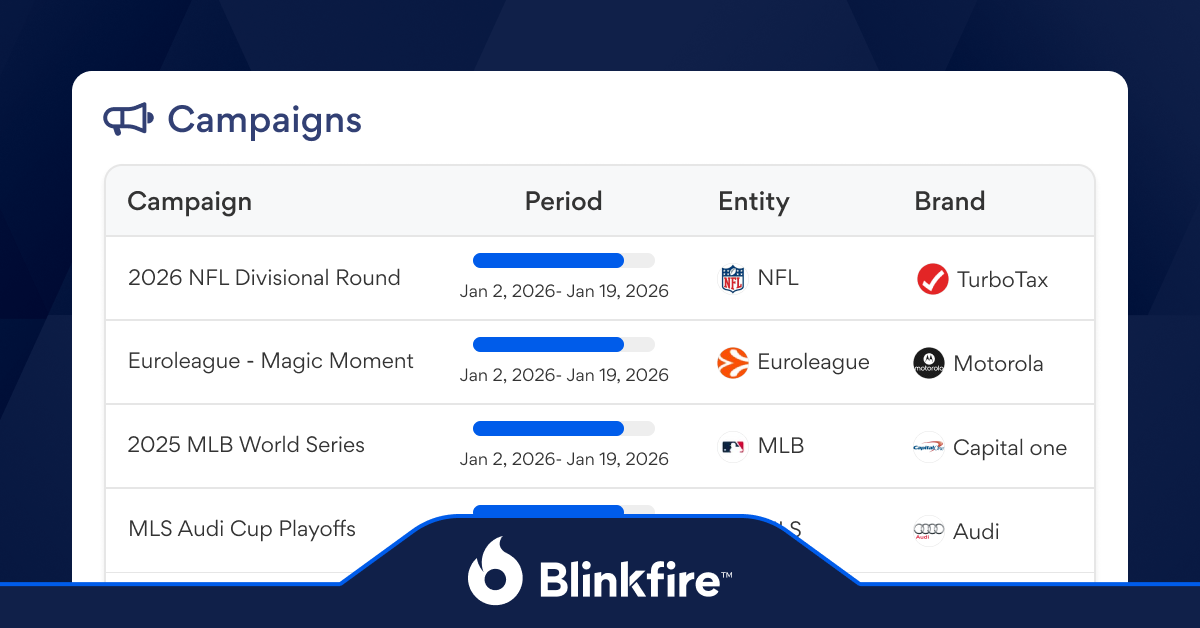
The beauty of a strategic campaign often lies in the logo lockup, that unique visual handshake between a brand and a team. Our tool allows you to upload these specific campaign creatives, add campaign-specific hashtags, and set customized exposure rules.
Once the parameters are set, Blinkfire’s patented AI and computer-vision technology takes over. Whether the campaign appears on a broadcast lower-third, a viral TikTok highlight, or a streaming overlay, Blinkfire captures it all. By setting a specific timeframe, you ensure that your report is surgical, focusing on the window of activation.
Example: MLB 2025 World Series – Sponsored by Capital One
Segmenting Success: Brand vs. Campaign
Why does segmentation matter? Because Brand Value and Campaign ROI are two different stories.
- Brand Valuation: Understand the total equity the partner is gaining across your entire ecosystem.
- Campaign Valuation: Pinpoint exactly how much value was driven by that specific initiative.
By separating these exposures, organizations can stay agile. Because Blinkfire updates in real-time, you don’t have to wait until the end of the month to see if a campaign is underperforming. If the numbers are soft on Tuesday, you can pivot your content strategy by Wednesday.
Example: Hotels.com In-Stadium Exposure vs Game Preview Campaign
White Space Analysis
Perhaps the most underrated feature of the Campaign Reporting tool is White Space Analysis. What if you have a high-performing asset with no current sponsor? By running a campaign report on your own unbranded content, you can show potential partners exactly what their ROI would have been had their logo been attached. It turns a sales pitch into a data-backed certainty, allowing you to show a brand the precise space they could own.
Example: Jersey Patch Valuation Using An Unbranded Patch
Key Features of Blinkfire’s Campaign Tracking
Success in modern sports marketing is about the agility to optimize every activation in real-time. Blinkfire’s Campaign Reporting tool is helping partners move from guesswork to precision. These AI-driven insights turn raw data into profitable strategies for organizations.
| Feature | Benefit |
| Real-Time Tracking | Users can optimize activations before it’s too late to recover value. |
| Custom Logo Integration | Users can upload their own custom logo lockups to track their unique campaigns. |
| Owned & Earned Integration | Capture value from your channels and everywhere else the campaign travels. |
| Multi-Channel Scope | One seamless report for Social, Digital, Broadcast, and Streaming. |
| Campaign-Specific Metrics | Go beyond the basic metrics and see advanced post-performance and value over time. |
Start Tracking Your Campaigns in Blinkfire
Blinkfire’s Campaign Reporting tool doesn’t just count logos; it validates strategies. It allows leagues, teams, agencies, media companies, and influencers to move away from guessing and toward proving.
Whether you’re reporting back to a long-term global partner or scouting for your next big deal, Blinkfire gives you the precision to tell the story of your success.
Written by
–
May 5, 2026
– 75 Views
PakarPBN
A Private Blog Network (PBN) is a collection of websites that are controlled by a single individual or organization and used primarily to build backlinks to a “money site” in order to influence its ranking in search engines such as Google. The core idea behind a PBN is based on the importance of backlinks in Google’s ranking algorithm. Since Google views backlinks as signals of authority and trust, some website owners attempt to artificially create these signals through a controlled network of sites.
In a typical PBN setup, the owner acquires expired or aged domains that already have existing authority, backlinks, and history. These domains are rebuilt with new content and hosted separately, often using different IP addresses, hosting providers, themes, and ownership details to make them appear unrelated. Within the content published on these sites, links are strategically placed that point to the main website the owner wants to rank higher. By doing this, the owner attempts to pass link equity (also known as “link juice”) from the PBN sites to the target website.
The purpose of a PBN is to give the impression that the target website is naturally earning links from multiple independent sources. If done effectively, this can temporarily improve keyword rankings, increase organic visibility, and drive more traffic from search results.